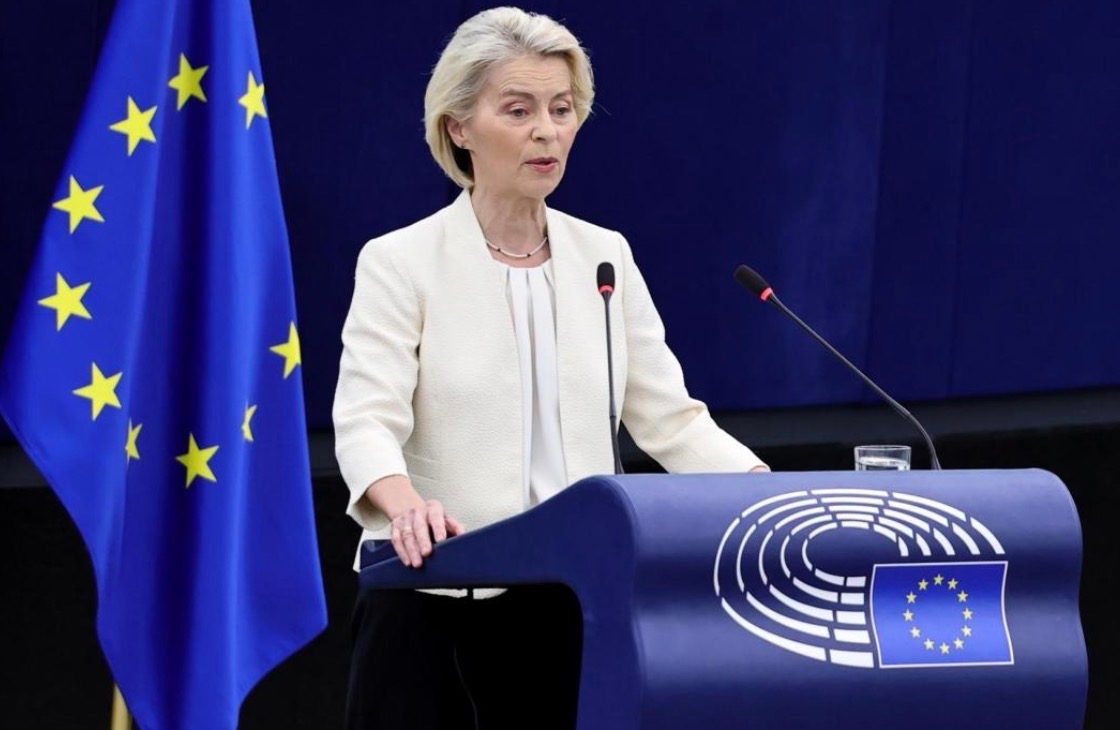
Ursula von der Leyen delivered her State of the Union address before the European Parliament on Wednesday. In a speech lasting more than an hour, she covered a wide range of topics, from climate protection to Ukraine and child protection on social media.
EU chief Ursula von der Leyen called for the creation of a "European Security Council", with countries including Britain and Ukraine, in her State of the European Union speech to the European Parliament in Strasbourg on Wednesday. Addressing this year's special guest, Canadian Prime Minister Mark Carney, von der Leyen said she wants to open the door for Canada to become the bloc's first associate member.
Von der Leyen proposed creating a European Security Council that could bring together the EU and partners such as Canada, Britain and Norway and establishing an "emergency security protocol" to allow EU members to trigger discussions to respond to crises.
“Europe needs its own counter-hybrid playbook,” said von der Leyen, referring to so-called hybrid attacks such as sabotage attempts.
When triggered by one member state, all member states would convene to coordinate a European response, to deter further escalation and to mitigate the impact," she said of the proposed protocol.
She went on to pledge that the EU would give its "strongest-ever support to Ukraine" over the forthcoming winter, which she said would be the toughest of the war triggered by Russia's invasion.
"Together with our partners, we will provide humanitarian aid and reinforce Ukraine’s supplies of power and heating," she said. "Second, we will strengthen Ukraine’s air defences," she added.
While acknowledging that US Patriot interceptor missiles needed to be delivered urgently, von der Leyen also noted that, "we must also jointly reduce our dependence on a single supplier" by developing with Ukraine "an affordable, modular missile-defence system".
EU to use all tools to cut 'unsustainable' China trade deficit
In her SOTEU address, von der Leyen said the bloc will use every possible means to reduce its "unsustainable" trade deficit trade with China.
Von der Leyen said that the imbalance, with a goods trade deficit of €1 billion ($1.15 billion) a day last year, had reached a tipping point and that Europe was already suffering from the second China shock through deindustrialisation.
EU leaders called on the European Commission in June to produce results from dialogue with China and to ensure the bloc has all the instruments it needed to defend its interests.
European Trade Commissioner Maros Sefcovic, leading the talks, said he wanted to achieve tangible results by October.
Von der Leyen said the European Parliament that it was in both sides' interests to work together to find a solution. Von der Leyen also highlighted the EU's reliance on China for many critical minerals, notably rare earths.
Von der Leyen also promised a new "heatwave plan" after the continent faced a deadly summer with record temperatures.
The EU will create a "climate insurance alliance" aimed at increasing insurance cover for extreme weather events, she said. The future of the bloc depends on how it manages climate change and Artificial Intelligence (AI), she noted.
The EU chief said she will invite the main frontier AI labs to discuss efforts to tackle the risks posed by AI. Anthropic and OpenAI are the leading frontier labs which build the most advanced, powerful and cutting-edge AI models in the world. Some researchers want AI to slow down.
Von der Leyen said landmark EU rules governing the use of AI adopted recently puts Europe in the position to shape global efforts to tackle the risks.
She is also proposing a social media ban for under-15s, saying that platforms have to prove that they are safe for children.
Von der Leyen's comments came amid growing worries about the potential danger posed by artificial intelligence.
The dangers were underscored by Anthropic researcher Jacob Coxon who resigned and accused both the company and OpenAI of racing toward self-improving superintelligence without acting responsibly. He had previously worked at OpenAI.
Von der Leyen said that under her proposal “mini accounts” chaperoned by guardians would be granted to kids aged 13-15.
The EU’s 27 member nations will now vote on the proposal, which could spark tensions with US President Donald Trump, who has long criticised Europe’s tech regulations.